
When PTSD Is Treated as a Crime: The Case of Kelsey Fitzsimmons and Why We Must Rethink Mental Health in Policing


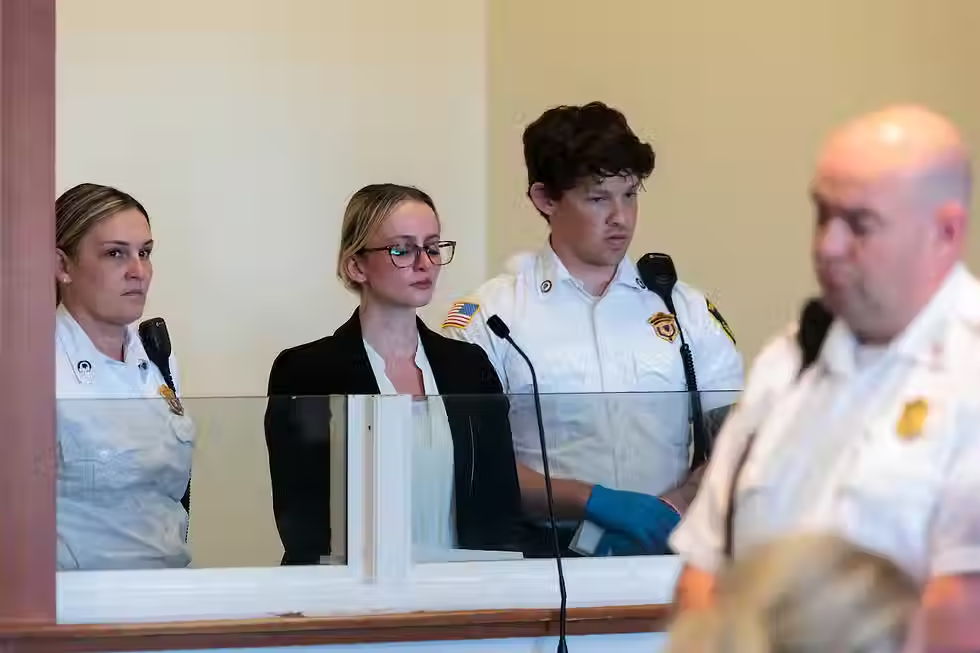
Kelsey Fitzsimmons’s story is heartbreaking, but it shouldn't be surprising. As a 28-year-old North Andover, Massachusetts police officer and new mother, she was exposed to unimaginable trauma. According to reports, Kelsey developed post-traumatic stress disorder (PTSD) after responding to a murder-suicide involving a mother and new baby while pregnant. Yet when she reached a breaking point, the legal system didn't respond with compassion, they responded with punishment.
After being served a restraining order by her ex-fiancé, North Andover firefighter Justin Aylaian, Kelsey reportedly went upstairs and retrieved a gun, aiming it at herself. In response, her former partner, claiming she pointed the gun at him, shot Kelsey multiple times and left her with broken ribs and life-threatening injuries. Rather than being treated as a person in crisis, Kelsey was held without bail as a “danger to the community.” A judge reversed that decision but later revoked bail again when she couldn't reliably comply with a court-ordered alcohol monitoring device, citing her injuries as the reason she couldn’t blow into it without intense pain. To call this “criminalizing mental illness” is not hyperbole, it's a reflection of a deeper systemic failure.
The Silent Crisis Among Law Enforcement
First responders work in environments with traumatic events. National data suggests police officers may witness three or more traumatic incidents every six months, racking up into hundreds over a career. That exposure has real consequences: PTSD, anxiety, depression, and burnout are significantly more common among officers than in the general population.
In fact, the Public Safety Officer Support Act of 2022 acknowledges just how widespread this issue is: congressional research cites rates of PTSD in law enforcement as high as 15%, with depression and suicide disproportionately affecting this profession. A report by the National Alliance on Mental Illness (NAMI) and other studies confirm that many officers feel isolated, afraid to seek help, or stigmatized by their peers or many officers hesitate to access mental health services out of concern it could damage their certification or career.

Criminal Law Isn't Therapy, But Courts Treated Kelsey Like She Needed Punishment
Kelsey’s case raises profound legal and ethical questions. When a person experiences a mental health crisis, especially one rooted in occupational trauma, should they be criminally punished or clinically treated? The legal system is reflexively punitive, often because there is no other ready path.
In Kelsey’s situation, the act that led to her shooting can be seen through multiple lenses: self-harm, a suicide attempt, and a psychological breakdown. Treating it solely as a criminal action ignores the reality of mental illness as a medical condition, one that requires care, not incarceration.
The revocation of her bail due to her inability to use a court-ordered SCRAM device underscores how tools of the criminal system can become instruments of suffering. Rather than accommodating her physical pain (broken ribs), the court penalized her. That’s not oversight, it’s disregard.
Legal Reform Is Not Just Compassion, It's Necessary for Justice
Kelsey’s case reflects a broader structural failure: our criminal justice system lacks effective mechanisms for responding to mental health crises, especially among first responders.
Here are three changes we must seriously consider:
Court-Mandated Mental Health Diversion: For individuals like Kelsey, whose crisis originates in trauma, not malice, diversion into mental health treatment (instead of jailing) should be a default, not an exception.
Reforming Bail Conditions: Conditions like alcohol monitoring devices (e.g., SCRAM) must account for physical and psychological capacity. Courts should avoid blanket "danger to self or others" labels without individualized assessments.
Institutional Wellness Programs: Agencies must commit to mental health support that’s both confidential and career-safe. Peer support, trauma-informed counseling, and policies that protect officers’ careers when they seek help are essential. This is not just for officer well-being, but because officers with untreated trauma pose safety risks themselves. The academic literature supports this: untreated PTSD can impair judgment, increase decision-making volatility, and even elevate risks during use-of-force encounters.
Why Kelsey’s Voice Matters, and Why the Legal System Should Listen
Kelsey isn’t just another statistic, her story is a powerful counterexample to a deeply entrenched narrative: that law enforcement culture is too tough, too resistant, or too fearful to acknowledge vulnerability. Her experience demands we ask ourselves: if a trained, compassionate, dedicated officer is treated like a risk, what hope is there for others?
Her case also challenges us to reconsider the role of the courts. Are they arbiters of safety, or gatekeepers of care? When mental health becomes part of the legal equation, justice must bend, not break.
It’s time to treat mental health in policing as a public health and legal issue, not a shameful secret or a disciplinary liability. Mental illness is not a crime; it never should be treated as one.
Until the Next Case,
Caroline Stella

Works Cited:
“Public Safety Officer Support Act of 2022.” Congress.gov, 2022,https://www.congress.gov/bill/117th-congress/senate-bill/3635
“Police Departments Struggle with Rising PTSD Cases Among Officers.” Stateline, Pew Charitable Trusts,https://www.pewtrusts.org/en/research-and-analysis/blogs/stateline
“First Responders and PTSD.” Substance Abuse and Mental Health Services Administration (SAMHSA),https://www.samhsa.gov
“Law Enforcement Mental Health and Wellness: A Report.” National Policing Institute,https://www.policinginstitute.org
Walden University. “PTSD in Law Enforcement: Understanding the Psychological Toll of Police Work.”https://www.waldenu.edu
Estes, Andrea. “Police Fear Seeking Mental Health Help Could Jeopardize Certification.” The Boston Globe,https://www.bostonglobe.com
“Depression, PTSD, and Suicide Among Law Enforcement Officers.” National Alliance on Mental Illness (NAMI),https://www.nami.org
Iowa Law Review. “Trauma-Informed Policing and the Legal System: Why PTSD Must Be Considered in Criminal Justice Responses.” Iowa Law Review,https://ilr.law.uiowa.edu
GovInfo. “PTSD in First Responders: Congressional Findings and Data.” U.S. Government Publishing Office,https://www.govinfo.gov


Comments